
10 February 2023
SEEING BY HEART
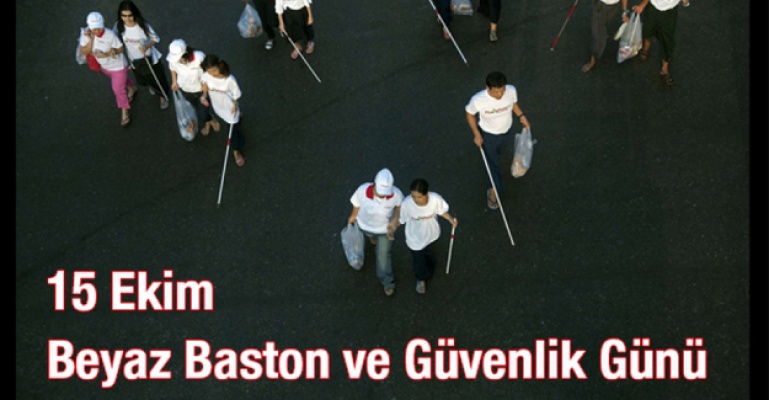
How to mark this special day. 15 October, which began in America and spread, has now started to be organised in our country too as “World Sight and White Cane Day”. On this occasion we bring up many subjects in the context of sight, blindness and people who are blind. Although after a certain time such special days begin to be received with some distaste, they can also be seen as an opportunity for good and beautiful things. That is what we try to do. Why not talk about the sense considered most important. For some reason the sense of sight is regarded as almost the most important sense in the world, and a whole set of feelings and perceptions arises accordingly.
That being so, should a quality regarded as the world's most important sense not be discussed at length? It should — and yet, perhaps because of an attitude of “why should we keep discussing something everyone agrees on”, we find that the subject is never discussed at all and that, sadly, there are many comical errors and misunderstandings. Indeed, far from merely witnessing them, I myself am among those who become the subject of such errors, almost like a joke.
Why grieve at being blind
In the first days after I became blind at the age of 11, those around me practically advised me to grieve because I was blind. With my child's mind, not knowing that “blindness was a reason for grief”, I could not understand why I ought to grieve. I still cannot understand it. Why? What do sighted people do in their lives that is different from people who are blind? Both sighted people and blind people read. Both sighted people and blind people can get jobs and work and earn their living. Both sighted people and blind people can marry and build a home. Both sighted people and blind people can carry out their social activities. True, not every sighted person and not every blind person can drive a car. Not every sighted person and not every blind person can paint. So why should I grieve? Another question is this: if I began to see right now, what would change in my life? Believe me, nothing at all.
Why such an obsession with sight
From time to time I hear things like “I don't believe it unless I see it with my own eyes” or “Did you see it with your own eyes, that you speak of it?” A colleague in the office said, “I'm off. I won't be back this evening,” and walked towards the coat rack to put on his jacket. I said, “Brother, take care not to put on my jacket by mistake.” He joked, “Lokman, do you think everyone is blind like you?” and we all laughed together. A little later it was time for me to leave, and my jacket was not there — my colleague's jacket was. I asked the others whether our friend had left without a jacket. They said one would not go to the place he was going without a jacket. We called our friend and asked: “Whose jacket are you wearing?” He looked and saw it was mine. Reading these lines you may think this an exceptional case. But my life is full of such things. In my talks I ask, “Do you remember the mehter march?” The hall answers, “Yes, 2 steps forward, 1 back.” And I reply, “It will be a little odd to learn the correct version from someone who is blind, but let me tell you: it is 2 forward and 1 pause.” Everyone in the hall is sighted, and somehow they see incorrectly a march they have seen with their own eyes. This is exactly why I cannot understand this exaggeration of sight, and the tying of life to it, despite seeing so wrongly and so little.
When are people governed by their eyes
I think no one believes any longer that we wear clothes solely and only to protect our bodies and keep from getting cold. The real purpose now is to make the person opposite us think about us in the way we want. A police uniform is worn so that we know that person is a police officer and behave accordingly. We often hear people say, “If I dress like this, they'll take me for such-and-such a person.” Signs and symbols always tell a sighted person what to do. The shapes of buildings, their colours, statues, banners, billboards and all those advertising elements are made to govern the mind of the sighted person and shape their thinking. Believe me, all of them know they cannot take command of the minds of people who are blind in this way. What should the framework of relations between blind and sighted people be. There is a wisdom in the existence of every being and every living thing. Trying to understand these things is our common gain. Whether they see or not, everyone's effort to know, understand and discover one another enriches everyone. The discoverer and the discovered are both enriched. Let us pause our conversation with this sentence, to talk of other dimensions another time: let us not place sight, blindness or our other differences as a barrier between us.