
8 February 2023
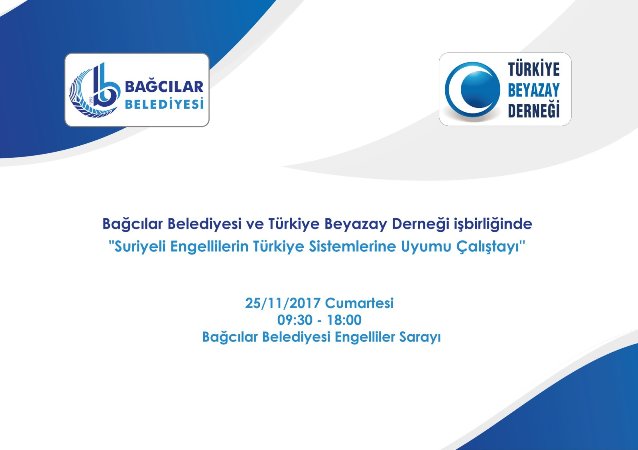
The Syria Commission of the Turkish Beyazay Association is organising, in cooperation with Bağcılar Municipality, a Syria Workshop with the participation of experts, aimed at resolving the problems of the Syrians who have been guests in our country for 6 years — above all in education, health, employment, social integration and technological support.
The Workshop on the Integration of Syrians with Disabilities into Türkiye's Systems will be held on Saturday 25 November at the Bağcılar Disability Centre. The workshop, which will comprise a main session followed by 5 parallel sessions and a concluding session, will also feature the story of Maher, a legend of success who is blind and who came from Syria, married in Türkiye and continues his university education, together with a talk drawn from the documentary filmed and the book written by the journalist and author Ms Ayşe Böhürler, a member of the Beyazay General Coordination Board.
The Education Session will be chaired by our former minister Prof. Dr. Ayşen Gürcan; the Health Session by Dr Aylin Çiftçi, founding Director General of Services for People with Disabilities and Older People and a member of the Beyazay General Coordination Board; the Employment Session by retired İŞKUR Chief Inspector Raşit Uluğbey; the Social Integration Session by Halis Kuralay, Deputy Provincial Director of Family and Social Policies in Istanbul and a member of the Beyazay General Coordination Board; and the Assistive Technologies Session by Dr Engin Yılmaz, Director of GETEM at Boğaziçi University.
Drawing attention to the importance of this Workshop, the Mayor of Bağcılar, Lokman Çağırıcı, said that more than 50,000 Syrian migrants are sheltering in the district. Çağırıcı said the Workshop is of great importance in identifying the problems and finding solutions within a short time.
Giving information about the work they carry out for the migrants, Çağırıcı explained that together with the District Directorate of National Education they had brought Syrian children into school.
Noting that they also provide important services for people with disabilities, Çağırıcı said: ‘‘Our Syrian brothers and sisters with disabilities who hold a residence document can make use of the vocational courses at our Disability Centre and of our Rehabilitation Centre. We are delivering many projects to enable people with disabilities to take part in social life.’’
On the subject, the President of the Turkish Beyazay Association, Lokman Ayva, said: “According to United Nations data, a total of 9 million people have been driven from their homes in the civil war in Syria that has continued for 6 years. More than 3 million people were forced to leave the country and to struggle for life as refugees, above all in our country. Although we cannot know the exact number, there are hundreds of thousands of women, young people and children who have become disabled for many reasons — injuries resulting from bombs and explosions, disabilities resulting in the loss of limbs, burns, illness and poverty. Türkiye provides Syrians with disabilities a level of service that cannot be compared with other countries. So that need and capacity may meet, we want the problems we do not know of and have not heard of to be identified and resolved systematically. At the end of the workshop we aim to obtain an action plan and a road map that we will implement together with world opinion, in the light of national and international experience. Beyazay's approach to problems is to turn disadvantage into advantage by understanding correctly and solving correctly,” he said.
The President of the Beyazay Syria Commission, Zehra Bayar, said: “A large proportion of the Syrians who are guests in our country are women and children. Some of the children and young people who were born here and have grown up in our country speak Turkish better than their families do. The majority do not want to return to their country even if the war ends. At this workshop we will hold, the topics that have emerged from the problems experienced over the past 6 years will be assessed by experts in the field.”